
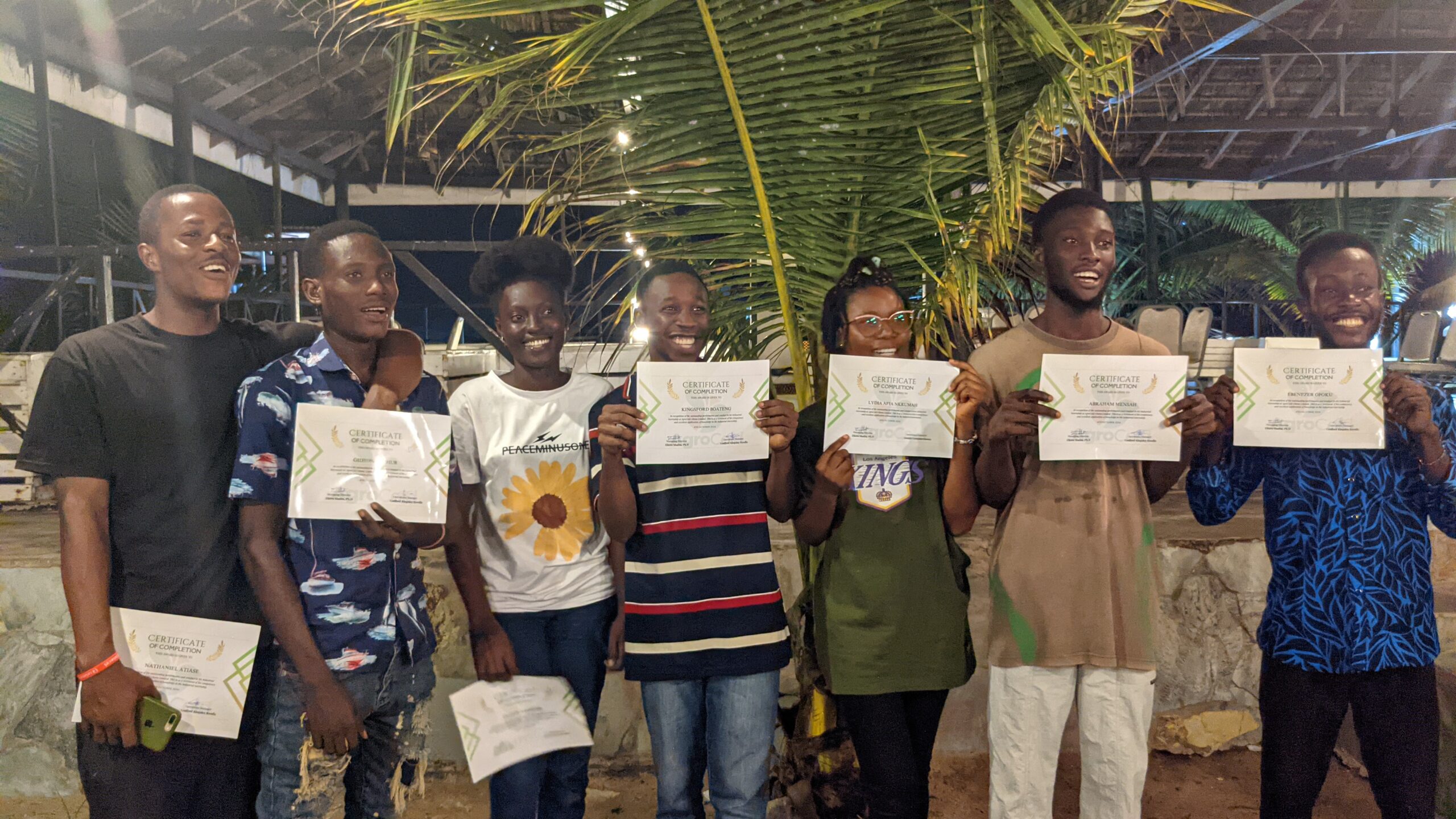
At AgroCold, we believe the future of climate-smart solutions in agriculture depends on equipping young people with practical skills across the entire agri-food system. During our internship cycle, we hosted students from the Department of Agricultural Economics and Extension, School of Agriculture, University of Cape Coast. They came in for hands-on training across our three areas of operation; advisory & production, storage, and marketing. The University mandated this internship to expose students to real challenges and opportunities within Ghana’s agri-food system. AgroCold fully integrated the interns into the company’s daily operations and decision-making processes.
Field advisory and production training
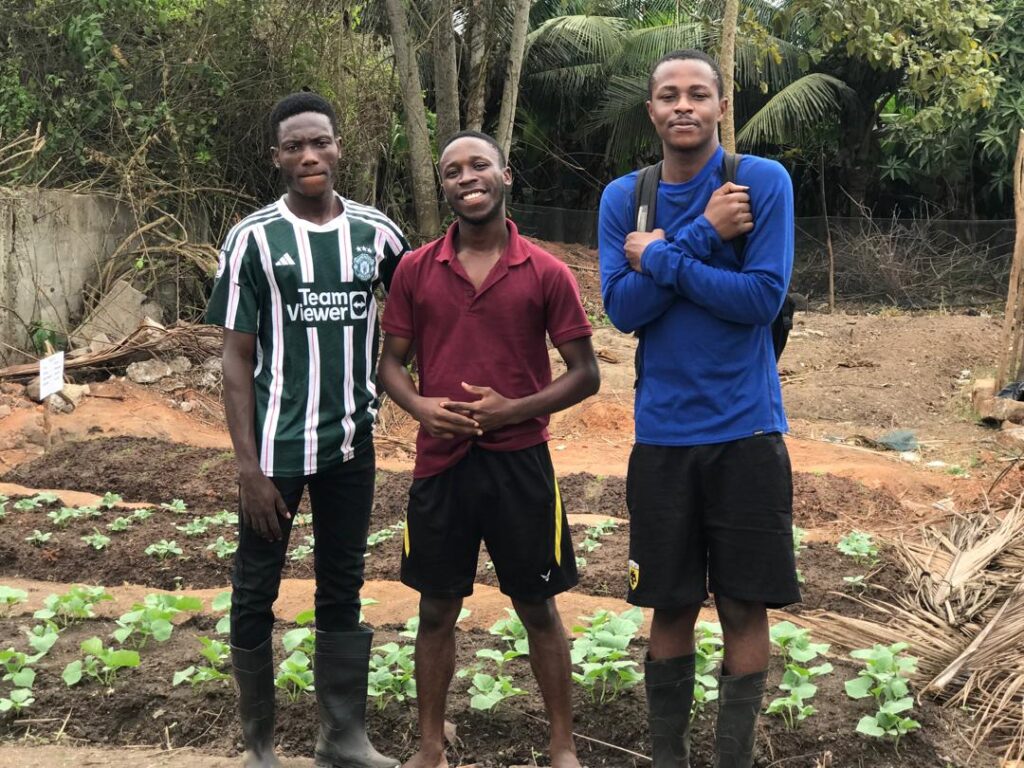
The advisory and production unit attached the male interns, who received practical training in vegetable production and extension methods. Specifically, they worked directly on demonstration plots, learning land preparation, crop budgeting, irrigation management, pest control, and harvest planning. The interns deepened their understanding of postharvest systems and rotated shifts at the cold storage unit, observing how temperature management, storage practices, and timing influence produce quality, shelf life, and market value. The experience helped them connect on-farm production decisions with postharvest outcomes and farmer incomes. One of the interns recalled his experience by stating:
Don’t forget the budgets and research on the vegetables, Dr. Shaibu said he will check. Let us draft our budgets, and list seeds, fertilizers, labour, water, tools, and transport. In addition, let’s calculate and recalculate. This budget is harder than farming!
Marketing
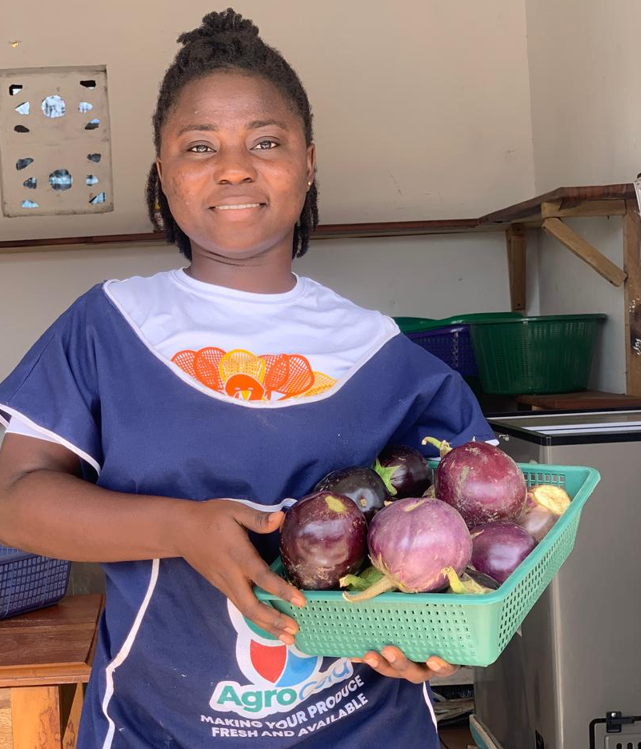
AgroCold attached the female interns to the marketing unit. They worked closely with smallholder farmers, traders, and customers who rely on the company’s services. They gained hands-on experience in:
- Order processing and inventory management
- Basic bookkeeping and financial recording
- Customer relations and service delivery
- Market coordination and produce aggregation
The interns regularly accessed the cold storage facility to store and retrieve produce, giving them practical insight into how cold chain systems support traders and smallholder farmers. Through this rotation, they learned how business operations, financial tracking, and customer engagement are essential to sustaining agricultural enterprises.
Across all units, the interns developed technical, business, and professional skills that go beyond the classroom. Moreover, they learned that agriculture is not only about production, but also about logistics, markets, finance, and teamwork.
Lessons shared
Boateng Kingsford:
I learned patience. Carrots taught me that the most important work is often invisible. As future extension agents, we will work with farmers where progress is slow. Trust takes time to grow, like carrot roots in the dark. I also learned that research and budgets are not optional but essential tools. You cannot advise a farmer if you don’t understand the numbers.
Opoku Ebenezer:
I learned to pay attention. Lettuce taught me that schedules are not enough. You must observe, check, and listen to the plants, to the soil, to the farmers. One miss in the irrigation process taught me more than a hundred lectures. I also learned that attention to detail affects the bottom line. Every wilted head of lettuce is money lost.
Gideon Arthur:
I learned resilience. My trellis collapsed, and I wanted to give up. But Janice, my supervisor didn’t let me. She made me rebuild. Failure is not the end, it is a feedback. I also learned that budgets must account for failure. Storms happen. Pests come. A good farmer plans for problems, not just perfect days.
Abraham Nana Mensah:
First, I learned the true meaning of service. For instance, spring onions taught me that I am not growing for myself; rather, I am growing for the customer, the market, and the farmer. Similarly, extension work follows this same principle, as I am not teaching for my own benefit, but instead for the farmer’s. My research and budget taught me that service must be sustainable. You cannot effectively help others if you do not manage your own resources well.
Key insights
The experience reinforced AgroCold’s commitment to nurturing young professionals who understand the full value chain and agrifood system. The company aims to prepare students and youth to become extension agents, agripreneurs, and food system leaders capable of addressing postharvest loss and strengthening resilient markets. AgroCold will continue its mission and contribute to raising young people in cold chain management, circular food use, and agribusiness operations.
Leave a Reply